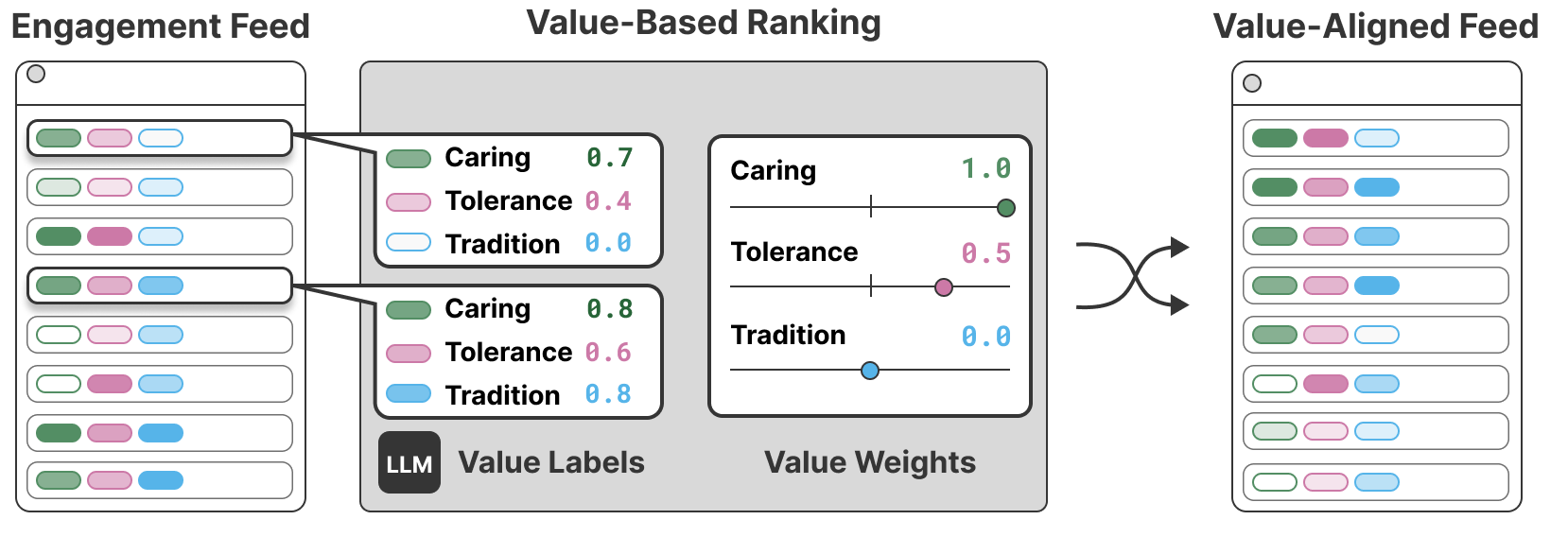
While social media feed rankings are primarily driven by engagement signals rather than any explicit value system, the resulting algorithmic feeds are not value-neutral: engagement may prioritize specific individualistic values. This paper presents an approach for social media feed value alignment. We adopt Schwartz’s theory of Basic Human Values --- a broad set of human values that articulates complementary and opposing values forming the building blocks of many cultures --- and we implement an algorithmic approach that models and then ranks feeds by expressions of Schwartz's values in social media posts. Our approach enables controls where users can express weights on their desired values, combining these weights and post value expressions into a ranking that respects users' articulated trade-offs. Through controlled experiments (N=141 and N=250), we demonstrate that users can use these controls to architect feeds reflecting their desired values. Across users, value-ranked feeds align with personal values, diverging substantially from existing engagement-driven feeds.
Our pipeline has three stages: classify values in posts, elicit user preferences, and re-rank the feed accordingly.
We use an LLM to score each of Schwartz's 19 values in social media posts from a user's engagement feed (e.g., FYP on Twitter/X) on a 0–6 scale.
Users report the values that they want to emphasize or deemphasize in their feed. We evaluate two methods for doing so: (1) deriving weights from validated survey measures and (2) allowing users to directly specify using slider controls.
Each post receives a score equal to the dot product of the user's weight vector w ∈ [−1, 1]19 and the post's value label vector. Posts are sorted in descending order of this score, with ties broken by the original engagement ranking.
Values adjacent on the circumplex share similar motivations; values on opposite sides are in tension.
Two pre-registered studies conducted on participants' own Twitter/X feeds.
N = 141 participants were shown side-by-side comparisons of the engagement feed and the value-ranked feed aligned to a single value.
They selected which feed reflected the named value with an accuracy rate of 76.1%.
N = 250 participants were given sliders to configure value weights based on their own selection. Participants were assigned to one of six conditions (allowed to change up to 1, 2, 3, 4, 5, or all 19 sliders).
Participants selected which feed reflected the named value with an accuracy rate of 63.4%, with a significant drop in recognizability when moving from one to multiple active values (72.6% → 61.5%).
Analysis of 212,663 tweets shows Hedonism (8.86 ± 4.31) and Stimulation (7.13 ± 3.08) dominate engagement-ranked feeds. Social values like Caring and Universal Concern are significantly underrepresented (personal-focus mean 4.14 vs. social-focus mean 1.55).
Mean Kendall's τ between value-ranked and engagement-ranked feeds is 0.06 ± 0.14 (range: −0.57 to 0.67), indicating current ranking algorithms fundamentally do not reflect users' desired values.
Recognizability drops when moving from one to multiple active values (72.6% → 61.5%), but remains above random chance even when all 19 sliders are active, confirming the approach is robust to complex value configurations.
@inproceedings{jahanbakhsh2026valuealignment,
      title={Value alignment of social media ranking algorithms},
      author={Jahanbakhsh, Farnaz and Zhao, Dora and Piccardi, Tiziano and
      Robertson, Zachary and Epstein, Ziv and Koyejo, Sanmi and Bernstein, Michael S},
      booktitle={ACM CHI Conference on Human Factors in Computing Systems (CHI)},
      year={2026}
}